




Spray painting is one of the most demanding manual skills in industrial finishing. Whether applied in automotive, aerospace, rail, marine, manufacturing, or maintenance environments, it requires far more than simply operating a spray gun. A professional painter must control distance, angle, speed, overlap, coating thickness, transfer efficiency, surface coverage, and defect prevention while also working safely around chemicals, fumes, pressurized equipment, and controlled environments. This is why augmented reality spray painting is becoming an important innovation in technical training: it allows learners to practice realistic painting movements while receiving digital feedback before entering a real booth.
What Is Augmented Reality Spray Painting?
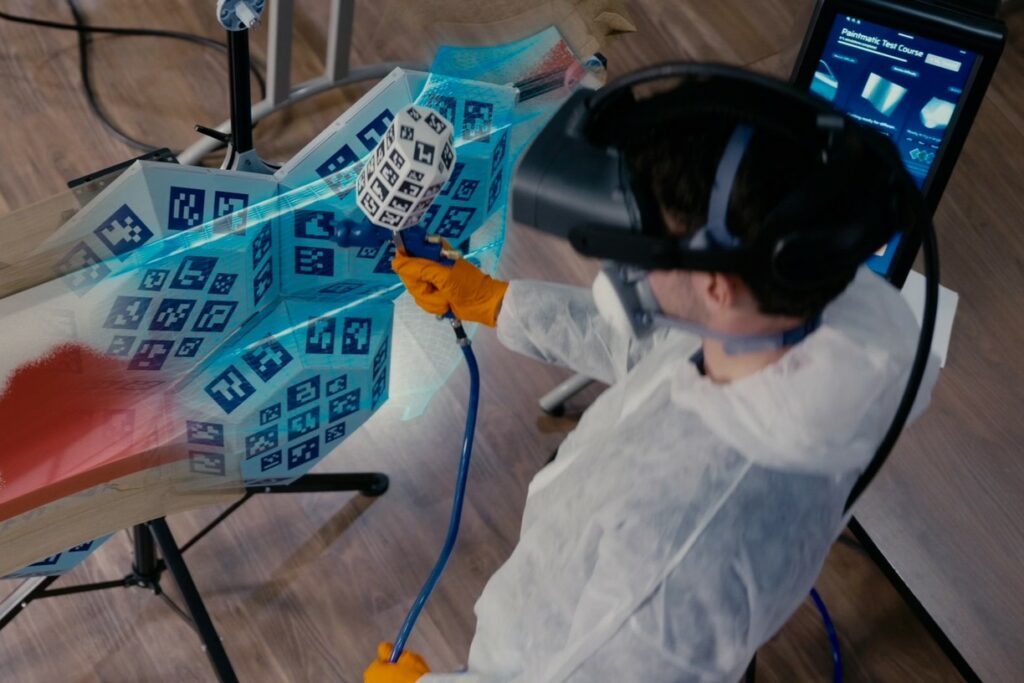
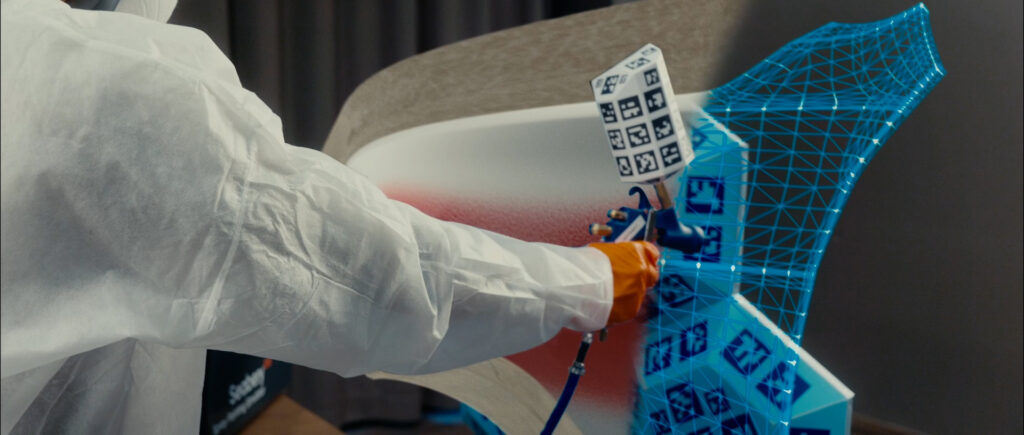
Augmented reality spray painting is a training approach that combines real physical movements with digital simulation. Unlike a purely virtual experience, augmented reality overlays digital information onto the real world. In spray painting, this means that trainees can hold a realistic spray gun, move around physical workpieces, and see simulated paint application, guidance, and performance results through an AR system.
The goal is not to replace real spray painting entirely. Instead, AR prepares learners before they consume paint, use solvents, enter spray booths, or work on expensive parts. This matters because spray operations involve both health and safety hazards, including exposure to sprayed materials, flammable liquids, and the need for proper ventilation and controlled work areas, as highlighted by OSHA spray operation guidance.
In practical terms, augmented reality spray painting helps learners build muscle memory. They repeat the same gestures required in real work: keeping the correct gun-to-part distance, maintaining a stable angle, controlling travel speed, and following the right trajectory. The difference is that mistakes are visible immediately and can be corrected without wasting coating material.
Why Spray Painting Is Difficult to Teach
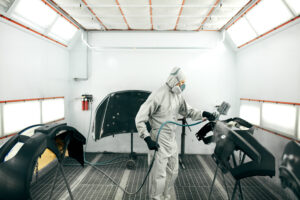
Traditional spray painting training can be expensive and complex. Every practice session may require consumables, booth time, ventilation, PPE, cleaning, waste management, and supervision. Beginners usually make mistakes, and those mistakes can generate overspray, poor finish quality, rework, or unsafe habits.
A typical learner must understand not only the theory of coating application but also the physical technique behind it. For example, moving too fast can create insufficient coverage, while moving too slowly can cause excessive thickness or sagging. Holding the spray gun at the wrong angle may lead to uneven coating distribution. Working too close or too far from the part affects transfer efficiency and finish quality.
This is where AR becomes valuable. By creating a safe and repeatable learning environment, instructors can allow students to practice more often and with more consistency. Broader industrial AR training solutions are increasingly used because they can reduce training time, support employee retention, improve collaboration, and lower training costs, according to PTC’s overview of augmented reality training.
How Augmented Reality Spray Painting Works
An augmented reality spray painting system generally combines hardware, software, tracking, analytics, and educational content. The trainee uses realistic equipment, performs real movements, and receives immediate visual or data-based feedback.
| Training element | What it does | Why it matters |
| Realistic spray gun | Replicates the weight, controls, and handling of real equipment | Builds authentic muscle memory |
| AR headset or display | Shows simulated coating, guidance, and results in the real environment | Connects physical movement with digital feedback |
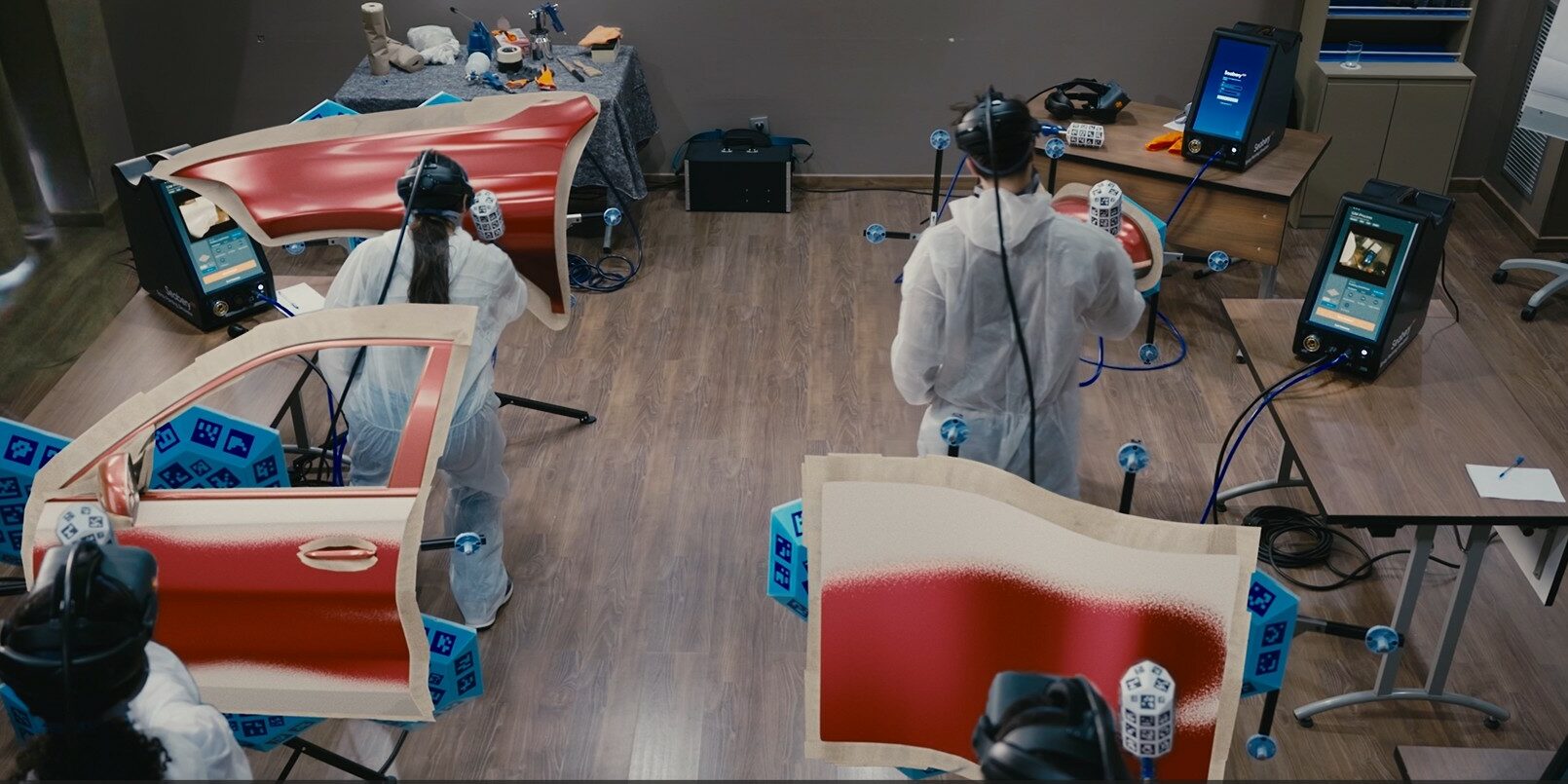
| Workpieces or coupons | Provide parts to practice on, from basic shapes to industry-style components | Makes training progressive and job-relevant |
| Visual guides | Indicate correct distance, angle, speed, and path | Helps learners self-correct during practice |
| Analysis module | Measures quality, defects, coating thickness, coverage, and technique | Gives instructors objective performance data |
| LMS or course integration | Connects exercises, student progress, and training programs | Makes AR suitable for structured education |
This combination makes the learning process more measurable. Instead of relying only on instructor observation, the system can capture objective indicators such as angle, speed, path, coating distribution, paint consumption, time spent, and visible defects.
Key Benefits of Augmented Reality Spray Painting
The first major benefit is cost reduction. Training with real paint requires materials, booth operation, filters, ventilation, cleaning products, and waste disposal. AR practice can reduce the number of real booth sessions needed before a learner is ready for live application.
The second benefit is safety. Spray finishing can involve physical and health hazards, and workers need to understand safe work practices, ventilation, PPE, and equipment handling. Practicing first in AR reduces early exposure while learners are still developing basic coordination. OSHA also lists spray operations under specific safety standards for general industry, maritime, and construction, reinforcing the importance of structured safety preparation.
The third benefit is environmental improvement. Less practice with real paint means less overspray, lower material waste, fewer cleaning chemicals, and reduced contamination during the early learning phase. This is especially relevant for training centers and companies that want to improve sustainability without compromising practical skills.
The fourth benefit is better learning engagement. Students often learn faster when they can see immediate consequences of their actions. Instead of waiting for a final inspection, they can understand during the exercise whether they are too close, too far, too fast, or applying too much coating.
What Skills Can Be Trained With AR Spray Painting?
Augmented reality spray painting can support a wide range of technical skills. These include gun distance, spray angle, travel speed, pass overlap, coating uniformity, part coverage, defect recognition, and finish consistency. More advanced systems can also simulate different paint products, part geometries, difficulty levels, and coating systems.
Instructors can use AR to create progressive exercises: basic flat surfaces first, then curved parts, complex shapes, or industry-specific components. This allows learners to build confidence step by step before moving into real production or workshop conditions.
AR vs. VR in Spray Painting Training
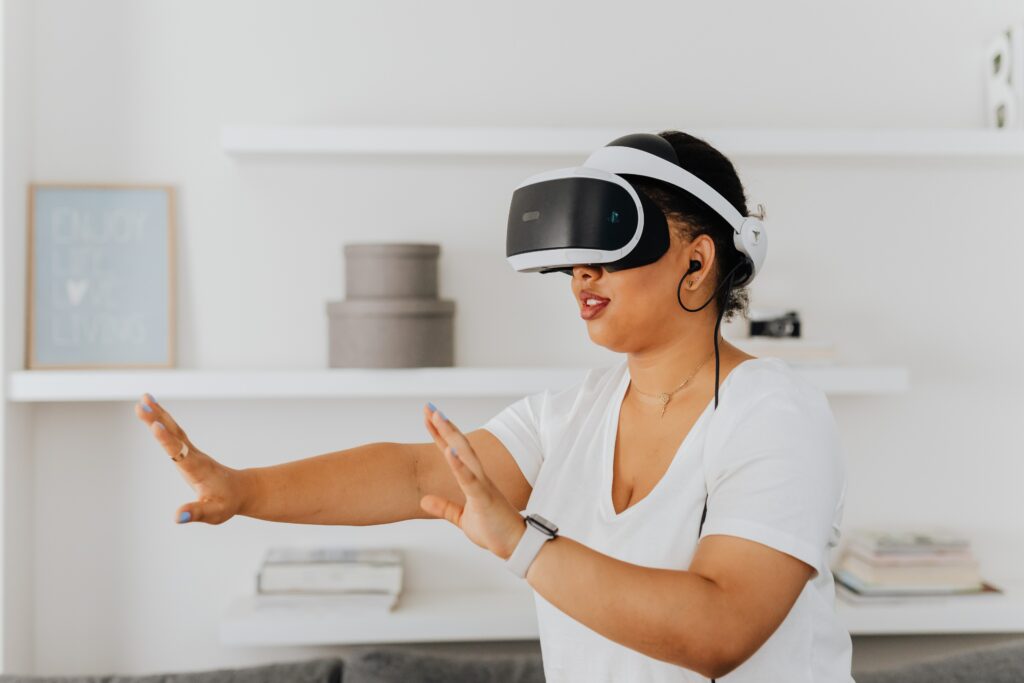
Virtual reality and augmented reality are often mentioned together, but they are not the same. VR places the user in a fully digital environment. AR keeps the user connected to the real environment while adding digital simulation layers.
For spray painting, this difference is important because the skill is highly physical. Painters must move their arms, position their body, maintain awareness of the part, and work in real space. AR allows trainees to practice these movements with real equipment and real spatial references, which can make the transition to actual spray painting more natural.
VR can be useful for conceptual learning or safety awareness, but AR is particularly strong when the goal is to develop manual technique. It gives learners the chance to practice as painters, not just as users interacting with a digital game.
Seabery’s Augmented Reality Spray Painting Solution
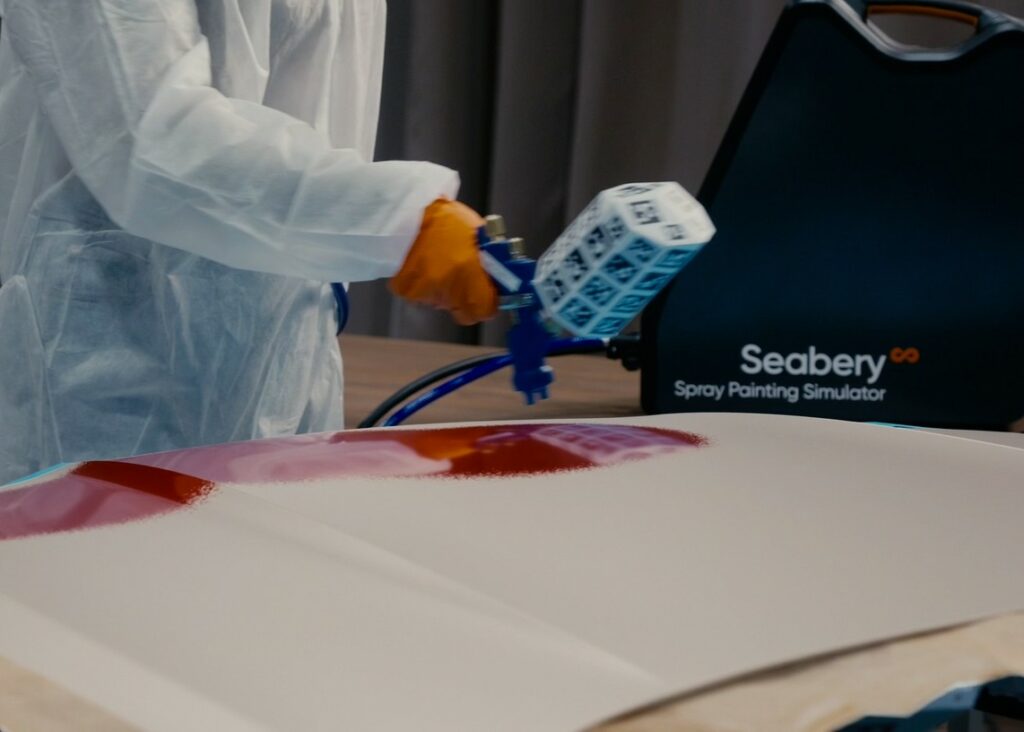
Seabery’s Spray Painting Simulator applies augmented reality to professional spray painting training with a turnkey methodology designed to train future expert painters for real painting applications. According to the brochure, the solution combines an ATHP platform, stereovision headset, realistic spray gun, ModulAR coupons, and workstand, creating a complete training environment powered by AR.
The system focuses on realism through real spray guns with real weight and controls, authentic PPE, parts based on common industrial use, high-realism graphics based on PBR and ray tracing, parametrized HD sound, precise calibration, and simulation based on real testing. It also analyzes painting quality and defects, helping learners understand not only how they performed but why a result was good or poor.
Seabery’s methodology also includes LMS connectivity and access to courses, allowing teachers to manage different students, levels, paces, and locations. The brochure highlights key advantages such as improving learning time, reducing costs, increasing engagement and painting time, lowering accidents, and supporting a more environmentally friendly training process.
A Smarter Way to Train Industrial Painters
Augmented reality spray painting makes technical training safer, cleaner, more measurable, and more accessible. It helps learners practice real movements with realistic tools while instructors gain objective data about performance and progress. For industries where coating quality, safety, and efficiency are essential, AR offers a practical bridge between classroom learning and real spray booth experience.
The Future of Spray Painting Training
Augmented reality spray painting is not just a technological upgrade; it is a new way to teach a complex manual profession. By combining real-world movement with digital guidance and analysis, it helps training centers and industrial companies prepare painters with greater confidence, fewer resources, and better control over learning outcomes.
Would you like to book a free online demo?
If you are interested in experiencing first-hand the power of Seabery Spray Painting Simulator, we invite you to complete our form to request a personalized demo – contact us now to explore the possibilities Seabery can offer your company or training center!